
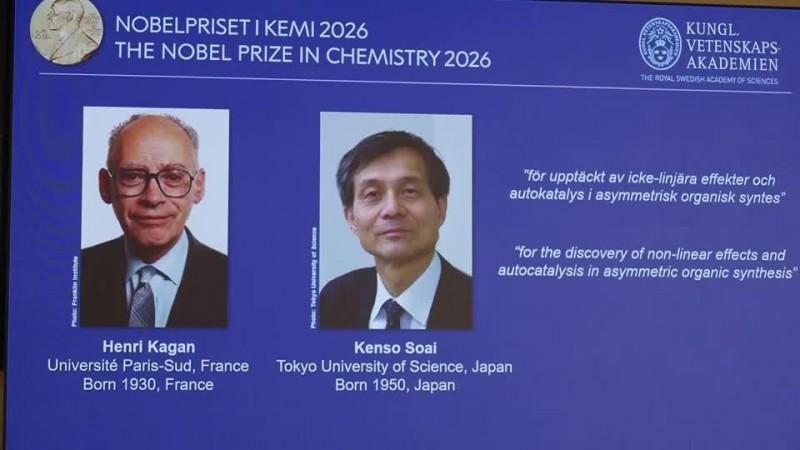
French chemist Henri B. Kagan and Japanese scientist Kenso Soai have been awarded the 2026 Nobel Prize in Chemistry for their groundbreaking discoveries that helped explain one of chemistry's long-standing mysteries — why many molecules essential to life exist predominantly in just one of two possible mirror-image forms.
The Royal Swedish Academy of Sciences awarded the prize to Kagan and Soai "for the discovery of non-linear effects and autocatalysis in asymmetric organic synthesis". Their work has helped scientists understand how a tiny imbalance between two molecular forms can be amplified until one form becomes dominant.
What is the 'handedness' of molecules?
The phenomenon is known as chirality, a term derived from the Greek word for hand. Just as the left and right hands are mirror images but cannot be perfectly superimposed on each other, some molecules also exist in two mirror-image forms.
These forms contain the same atoms but can behave differently when interacting with living organisms. Amino acids, for example, exist in two mirror-image versions, but living organisms overwhelmingly use only one of them to build proteins. This one-sided chemistry is known as homochirality.
For more than a century, scientists have wondered how this preference emerged. Chemical reactions that can produce both forms would generally create them in roughly equal amounts, making it difficult to understand how life ended up favouring one molecular form.
How did Kagan and Soai solve the mystery?
Kagan made a major breakthrough in 1986 when he discovered a way to manipulate chemical reactions so that one mirror-image form could be produced in greater amounts than the other.
Soai later took the research further. In 1995, he designed a chemical reaction with the potential to become completely one-sided. In 2003, he demonstrated a reaction in which only one of the two possible mirror-image forms was produced.
The key to their work was understanding non-linear effects and autocatalysis. In simple terms, a small initial imbalance can reinforce itself during a reaction, allowing one molecular form to become increasingly dominant.
The Nobel Committee said their discoveries provided a solution to a chemical mystery that is more than 100 years old — how homochirality can emerge spontaneously.
Why is the discovery important?
The research has implications far beyond understanding the origins of life's chemistry. It is particularly important in pharmaceutical development, where the two mirror-image forms of a molecule can have very different effects inside the human body.
Being able to control which molecular form is produced allows scientists to develop chemical reactions that generate the desired version more precisely. The discoveries have therefore become important in the manufacture of medicines, as well as in the development of flavours, fragrances, agricultural chemicals and certain materials.
The 2026 Nobel Prize in Chemistry carries a total prize amount of 12 million Swedish kronor, which will be shared by the two laureates. They will receive their medals at the Nobel Prize ceremony in Stockholm on December 10.